
Published on January 24, 2026


KATHMANDU: Mountain guides have called on the government to invest in producing skilled human resources to strengthen Nepal’s mountaineering tourism, citing rising international demand for trained Nepali guides and a growing shortage of qualified manpower.
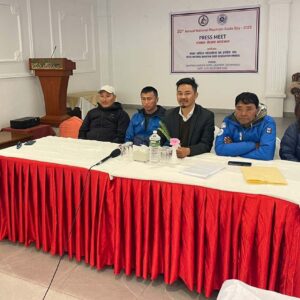
Speaking at a press meet organised in Kathmandu on the eve of National Mountain Guide Day, the Nepal National Mountain Guide Association (NNMGA) stressed that sustained state investment in training is essential to develop competent guides with strong safety knowledge, technical skills and international credibility.
The association said the number of mountaineers visiting Nepal is increasing every year, which has also raised demand for reliable and professionally trained Nepali guides both at home and abroad. However, limited training opportunities and high costs are preventing the sector from expanding in line with its potential.
Established in 2004, NNMGA received official recognition from the International Federation of Mountain Guides Associations (IFMGA) in 2012, becoming Nepal’s national representative body. Since then, the association has been conducting IFMGA guide courses in Nepal and has produced more than 100 internationally certified mountain guides, the highest global qualification in mountaineering.
An IFMGA licence allows guides to lead, train and teach rock climbing, ice climbing and alpine mountaineering in member countries worldwide.
“Tourism has immense potential in Nepal, and mountaineering tourism is one of its major income sources. There is strong international demand for Nepali guides, but we simply do not have enough qualified manpower,” said NNMGA President Tul Singh Gurung.
According to the association, Nepali guides regularly work on a seasonal basis in Europe, North America and Scandinavian countries, with around 15 guides travelling to Norway each year. During the 2025 Everest climbing season, many companies sought IFMGA-certified guides, but the demand could not be fulfilled due to limited numbers.
While mountaineering activities expanded significantly after Tenzing Norgay Sherpa and Sir Edmund Hillary summited Everest in 1953, NNMGA noted that Nepalis had been working in the mountains nearly five decades earlier, underscoring a long history that has yet to be fully developed in terms of skills and professional standards.
The association said basic mountaineering training programmes supported by the Nepal Mountaineering Association before Covid-19 were halted after the pandemic. It estimates that becoming an international-level mountain guide takes around seven years and costs about Rs 1.7 million, which has discouraged many young people from entering the profession.
NNMGA General Secretary Pemba Tenzing Lama emphasised the need for youth-targeted subsidy and support programmes to attract new entrants and ensure continuity in the sector.
Topo map construction begins
On the occasion of its 20th anniversary, NNMGA also announced the start of topo map construction for rock climbing sites in Nepal for the first time, aimed at improving access, safety and pre-climb preparation.
National Mountain Guide Day is observed on Poush 10 (December 25), marking the day mountain guiding was officially recognised in Nepal in 2004. A press conference was held in Kathmandu on Thursday to discuss the past and present state of Nepali mountain guides and mountain safety.
President Gurung said topo map work has begun at the Hattiban rock climbing site and will be gradually expanded to major climbing destinations across the country. The maps will provide detailed information on routes, difficulty levels and access points.
President of the Nepal Mountaineering Instructors Association (NMIA) Tshering Pandey Bhote, said rock climbing is the foundation of mountaineering training, and expanding topo maps will help increase climber numbers and improve guide training standards.
Over 100 certified mountain guides
According to NNMGA, Nepal now has 107 internationally certified mountain guides. Although guides are not produced every year due to the lengthy and demanding training process, interest in the profession is gradually increasing.
Internationally certified Nepali guides are currently working in 26 mountainous countries, and some are also serving as instructors in India and China, the association said.
NNMGA is a not-for-profit professional body representing trained and certified mountain guides in Nepal and works to promote professional guiding standards and Nepal’s mountain tourism at both national and international levels.